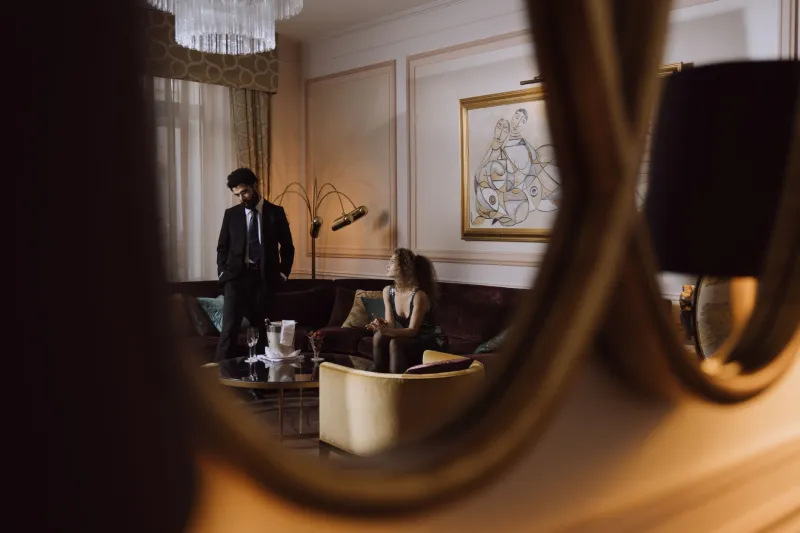
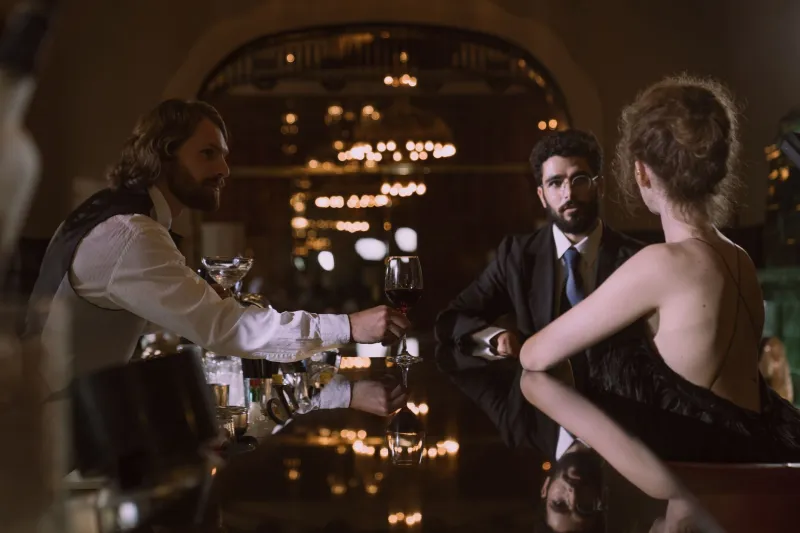
Fully Here: The Vanishing Art of Genuine Presence and Why It Commands a Premium

There is a particular quality that the most memorable human encounters share — a quality that is difficult to name but immediately recognizable when experienced. It is the sensation of being met, completely and without reservation, by another person. No wandering gaze. No half-formed thoughts drifting toward a waiting inbox. No performance of attentiveness masking an interior monologue about something else entirely. Just two people, occupying the same moment with genuine intention.
This quality — authentic presence — was once unremarkable. Today, it is extraordinary.
The Distraction Economy and Its Casualties
The United States now operates within what researchers and cultural critics have begun calling the "attention economy" — a commercial ecosystem engineered, at an almost molecular level, to fragment human focus. Smartphones deliver an average American over four hours of screen engagement per day. Notification architecture is deliberately designed to interrupt, to pull consciousness away from wherever it has settled. Even social gatherings, once the natural habitat of genuine human exchange, have been colonized by the compulsive need to document, share, and perform.
The casualties of this environment are not merely productivity metrics or sleep quality. The deepest casualty is relational depth. When presence becomes conditional — offered only in the gaps between digital obligations — the quality of human connection degrades in ways that are felt long before they are fully understood. Conversations grow shallower. Listening becomes a courtesy rather than a commitment. And the experience of being truly seen by another person grows rarer with each passing year.
This is not a small thing. Psychologists have long established that the experience of genuine attentiveness — being the undivided focus of another person's care and curiosity — is foundational to human well-being. Its absence registers not merely as inconvenience but as a form of emotional deprivation.
Presence as Performance vs. Presence as Practice
It is worth distinguishing between two very different things that often wear the same name. There is the performance of presence — the practiced simulation of attentiveness that many people have developed as a social survival skill. Eye contact maintained at calculated intervals. Affirmative sounds deployed at appropriate pauses. The outward architecture of engagement, inhabited by an interior that is elsewhere.
And then there is presence as an actual practice — a cultivated discipline that requires real psychological effort and genuine intention. This is the capacity to suspend one's own agenda, to release the impulse to redirect a conversation toward more comfortable territory, to sit with another person's reality without immediately trying to resolve or reframe it. It is, in the truest sense, a skill — one that requires development, maintenance, and conscious choice in every interaction.
The distinction matters enormously in the context of companionship. Most people, even those with excellent social instincts, are operating in performance mode far more often than they realize. Genuine presence — the practiced, intentional kind — is something far less common and, consequently, far more valuable.
Why Transactional Relationships Erode Authentic Connection
Modern American social life is, in many respects, increasingly transactional. Professional relationships are structured around deliverables. Romantic partnerships carry the weight of mutual expectation and long-term negotiation. Even friendships are often managed across scheduling apps and group chats, their intimacy diluted by the sheer logistics of contemporary life. In nearly every relational context, there is an agenda — spoken or unspoken — shaping the encounter.
This is not a moral failing. It is a structural reality. But its effect on the quality of human presence is significant. When every interaction carries an implicit ledger — of favors owed, impressions managed, outcomes pursued — the space for pure, agenda-free attentiveness shrinks accordingly. People cannot be fully present when they are simultaneously calculating.
This is precisely why discerning individuals increasingly seek companionship experiences that are explicitly structured to remove that ledger. When the terms of an engagement are clear, defined, and mutually agreed upon in advance, a remarkable thing becomes possible: both parties can simply be present. The mental overhead of social negotiation dissolves. What remains is the encounter itself.
The Psychology of Being Witnessed
There is a concept in contemporary psychology — sometimes called "feeling felt" — that describes the experience of having one's inner state accurately perceived and acknowledged by another person. Research consistently identifies this experience as one of the most powerful contributors to emotional well-being and relational satisfaction. It is, in essence, the psychological reward of genuine presence.
The hunger for this experience is not a sign of weakness or insufficiency. It is a fundamental human need, as basic in its way as physical safety or social belonging. And like many fundamental needs, it has become harder to meet in the context of modern American life — not because people care less about one another, but because the conditions that allow for genuine witnessing have become structurally difficult to create.
High-quality companionship, at its most refined, addresses this need directly. A skilled companion does not merely occupy space in a social setting. She or he brings a quality of focused, generous attention that most clients encounter rarely, if ever, in their daily lives. The effect is often described in terms that sound almost therapeutic: a sense of being restored, recalibrated, reminded of one's own significance.
Investing in the Irreplaceable
The most sophisticated clients of premium companionship services are not, by and large, seeking novelty or spectacle. They are seeking something far more specific and far more elusive: the experience of genuine human presence, offered without distraction, without agenda, and without the complicated weight of ongoing relational obligation.
This is a discerning preference, and it reflects a clear-eyed understanding of what is actually scarce in contemporary life. Time is scarce, certainly. But authentic attention — the kind that makes a person feel genuinely encountered — is scarcer still.
At Riti Mescort, the curation of premium companionship begins with precisely this understanding. The companions featured through this platform are selected not merely for social polish or aesthetic appeal, but for the less visible and more consequential quality of genuine relational presence. The ability to be fully in a room — to make another person feel, without artifice or effort, that they are the sole and worthy focus of a shared moment — is treated here not as a bonus feature but as a foundational standard.
Because in the end, that is what the discerning client is actually purchasing. Not an evening. Not an appearance. Not a performance. But the rare and increasingly valuable experience of being, for a defined and meaningful period of time, truly met.
In a world that has made distraction its default setting, that experience is worth exactly what it costs.