Silence Is the New Luxury: How Undistracted Conversation Became the Status Symbol of the Modern Elite

There is a particular kind of exhaustion that no amount of first-class travel, fine dining, or tailored clothing can resolve. It is the fatigue of never being fully met in conversation — of watching a dinner companion's eyes drift toward a glowing screen mid-sentence, or of finishing a long workday having exchanged hundreds of messages without once feeling genuinely understood. For a growing segment of high-net-worth Americans, this exhaustion has quietly redefined what luxury actually means.
Material goods, for all their appeal, have reached a kind of saturation point among the ultra-affluent. The private jet, the Napa Valley estate, the Rolex on the wrist — these remain markers of success, certainly, but they no longer distinguish a person within circles where everyone possesses them. What does distinguish, increasingly, is access to something far more elusive: another human being's complete, uninterrupted attention.
The Neuroscience Behind the Crisis of Attention
To understand why presence has become so rare, it helps to understand what the smartphone era has done to the human brain. Neurological research consistently demonstrates that the dopaminergic reward system — the brain's mechanism for seeking pleasure and motivation — responds to unpredictable social stimuli with particular intensity. Every notification, every new message, every algorithmically curated feed update delivers a small but measurable dopamine hit. Over time, the brain recalibrates its baseline expectations accordingly.
The consequence is not merely distraction in the colloquial sense. It is a structural rewiring of attentional capacity. Studies conducted at institutions including the University of Texas at Austin have suggested that the mere presence of a smartphone on a table — even face down, even silenced — measurably reduces available cognitive capacity for the people nearby. The device does not need to be actively used to fragment attention; its potential demands enough.
For professionals who operate at the highest levels of business, law, finance, or creative industry, this cognitive fragmentation carries real costs. Decision fatigue, diminished empathy, and a persistent sense of conversational incompleteness are among the most commonly reported complaints. The irony, of course, is that the same technology that accelerated their professional ascent now interferes with the quality of their personal lives.
When Conversation Becomes a Commodity
Economists occasionally describe the concept of Veblen goods — items whose desirability increases as their price rises, precisely because scarcity and exclusivity are part of their appeal. Genuine conversational presence has begun to function in a similar manner within certain social and professional ecosystems. Its value is inseparable from its rarity.
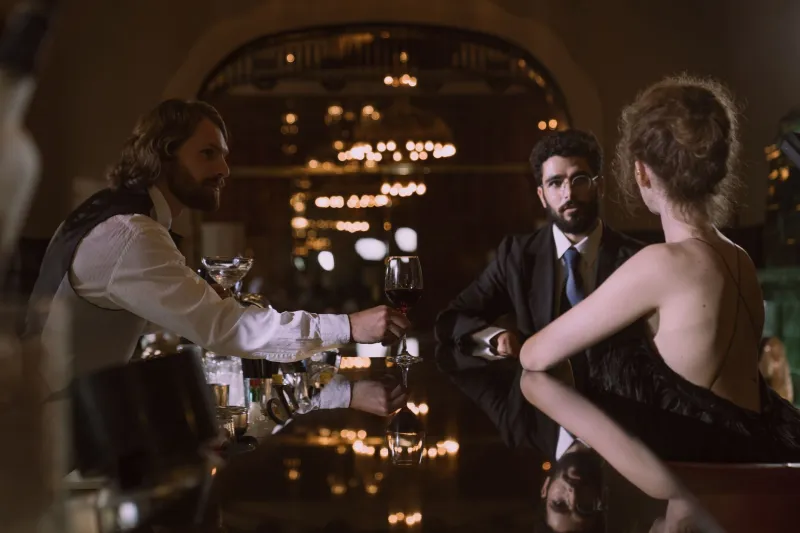
Consider what it requires to have a truly uninterrupted dialogue in contemporary American professional life. Both parties must be willing to silence their devices entirely. Both must bring a degree of emotional attentiveness that is, frankly, difficult to sustain after a twelve-hour workday. Both must be genuinely curious about the other person rather than waiting for their next opportunity to speak. These conditions, unremarkable in their description, are vanishingly uncommon in practice.
This is precisely the environment in which premium companionship services have found a significant and growing dimension of their value proposition. The most discerning clients engaging with platforms such as Riti Mescort are not simply seeking social company in the transactional sense. They are seeking a curated, intentional form of presence — an encounter where the companion's full intellectual and emotional engagement is not incidental but foundational to the experience.
The Affluent Professional and the Search for Genuine Dialogue
It is worth examining who, specifically, is driving this shift in perception. Behavioral research on high-net-worth individuals in the United States consistently identifies a particular profile: professionals between the ages of 38 and 62, typically operating in leadership roles, who report high levels of social connectivity alongside pronounced feelings of interpersonal isolation. The paradox is well-documented. These individuals are surrounded by people — staff, colleagues, family, acquaintances — and yet rarely experience conversation that feels genuinely mutual.
Part of this stems from the asymmetries inherent in professional power. When one person in a conversation holds significantly more social or financial capital than the other, authentic dialogue becomes structurally difficult. Subordinates self-censor. Acquaintances perform. Even close friends may unconsciously calibrate their words to what they believe the affluent individual wishes to hear. The result is a kind of conversational loneliness that is difficult to articulate and rarely acknowledged publicly.
Premium companionship, when approached with professionalism and mutual clarity, offers a different dynamic. A skilled companion brings not deference but genuine engagement — intellectual curiosity, emotional attentiveness, and the social fluency to navigate a wide range of topics without either flattery or agenda. The conversation that emerges from such an encounter is frequently described by clients as among the most stimulating and restorative they experience.
Presence as Practice, Not Performance
There is a meaningful distinction between performed attentiveness and actual presence. The former — the practiced nod, the sympathetic expression deployed on schedule — is detectable, and its detection produces the opposite of connection. Authentic presence, by contrast, involves a genuine suspension of one's own internal monologue in favor of active, curious listening. It is a discipline, one that requires both inclination and cultivation.
The companions who distinguish themselves within the premium market understand this distinction intuitively. Their value lies not in appearance alone, nor even in conversational repertoire, but in a quality of attentiveness that clients describe, repeatedly and across very different demographics, in strikingly similar terms: they felt, for the duration of the encounter, as though they were the most interesting person in the room. Not because they were flattered. Because they were actually listened to.
This is not a small thing. Psychological research on human wellbeing identifies feeling genuinely heard as one of the most consistent predictors of emotional satisfaction and relational fulfillment. It is, in a very real sense, a fundamental human need — one that the modern attention economy has made systematically difficult to meet.
Redefining What Affluence Actually Buys
The cultural conversation around luxury is slowly, but perceptibly, shifting. Among the most forward-thinking segments of American affluence, experiential wealth — the richness of one's lived moments — is increasingly prioritized over acquisitive wealth. This shift has been noted by sociologists, luxury brand consultants, and wellness economists alike. The question animating it is simple: what actually makes a life feel full?
Undistracted conversation, it turns out, makes a compelling answer. Not because it is sentimental or retrograde, but because it is genuinely rare, deeply restorative, and available only through intentional cultivation. For those who have the means to seek it out deliberately — and the self-awareness to recognize what they have been missing — it represents a form of richness that no algorithm can replicate and no notification can interrupt.
At Riti Mescort, we recognize that the most sophisticated clients understand this implicitly. The curated companionship experiences we facilitate are built on a foundation of genuine human engagement. Because some things, it turns out, are still worth paying for — not because they are expensive, but because they are real.